

Article content
Every few years, organizations are told that the next platform will change everything.
A new customer relationship system will create visibility.
A new collaboration tool will improve communication.
A new automation platform will eliminate repetitive work.
A new artificial intelligence assistant will make the organization faster, smarter, and more efficient.
Each promise may contain some truth. Technology can improve workflows, reduce manual effort, expand access to information, and help people make better decisions.
Yet many leaders continue to experience the same underlying frustration:
Why does work still feel harder than it should?
The answer is rarely that the organization lacks technology.
More often, the organization has accumulated technology without creating a shared understanding of how the institution is supposed to work.
The result is not transformation.
It is fragmentation.
The Hidden Cost of Disconnected Systems
Most organizations did not deliberately design a disconnected technology environment.
It developed gradually.
One department selected a system to manage customers. Another adopted software for projects. Finance established its own reporting environment. Leadership received information through presentations and spreadsheets. Documents accumulated across shared drives, email accounts, collaboration platforms, and individual computers.
Each decision may have been reasonable on its own.
Together, however, those decisions created an organization in which information is distributed across tools that understand only a small part of the institution.
Employees compensate for this fragmentation every day.
They search for information they know exists but cannot locate.
They re-enter data that another department has already captured.
They reconcile reports containing different definitions of the same metric.
They rebuild context when responsibilities move from one person to another.
They make decisions using partial information because the full organizational picture is difficult to assemble.
This is not simply an inconvenience.
It is an institutional cost.
Fragmented systems reduce organizational capacity by consuming time, weakening continuity, obscuring accountability, and preventing knowledge from becoming a shared institutional asset.
Why Digital Transformation Often Stalls
Digital transformation is frequently described as a technology initiative.
That framing creates a predictable sequence.
First, an organization identifies a visible problem.
Then it searches for a platform that appears capable of solving it.
Implementation begins before the organization has established a complete understanding of the workflow, the people involved, the decisions being made, the knowledge required, or the governance necessary to sustain the change.
The technology may be installed successfully while the organization remains largely unchanged.
A manual process becomes a digital process.
A confusing workflow becomes an automated confusing workflow.
An information gap becomes a dashboard built on incomplete information.
A governance problem becomes a permissions problem.
The implementation may technically succeed while the modernization effort fails to strengthen the institution.
This is why modernization should not begin with the question:
Which tool should we implement?
It should begin with a more important question:
How does our organization actually work—and how should it work in the future?
Artificial Intelligence Does Not Eliminate the Need for Understanding
Artificial intelligence has intensified the pressure to modernize.
Organizations are being encouraged to automate knowledge work, deploy intelligent assistants, connect large language models to internal documents, and introduce AI into decision-making.
These capabilities can create significant value.
But AI does not remove the need for organizational understanding.
It makes that need more urgent.
An AI system can only reason from the information, context, and authority made available to it.
When organizational knowledge is incomplete, outdated, contradictory, or scattered across disconnected systems, AI inherits those weaknesses.
When roles and decision rights are unclear, automation can accelerate confusion.
When governance is absent, speed can increase risk rather than value.
When institutional knowledge remains trapped in the experience of individual employees, an AI assistant may retrieve documents without understanding how the organization truly operates.
The central question is therefore not whether an organization should use artificial intelligence.
The central question is whether the organization has developed the understanding, governance, knowledge, and operational clarity required to use it responsibly.
AI can strengthen an intelligent organization.
It cannot substitute for one.
What a Smarter Organization Looks Like
A smarter organization is not simply an organization with more advanced software.
It is an organization in which people, processes, knowledge, governance, and technology reinforce one another.
Leadership has access to information that reflects how the institution actually operates.
Departments share a common understanding of organizational priorities.
Important decisions are documented clearly enough to inform future judgment.
Knowledge created through projects, client relationships, operations, and leadership experience becomes available to the wider institution.
Technology supports established responsibilities rather than obscuring them.
Artificial intelligence augments human judgment without eliminating human accountability.
The organization learns continuously because experience is intentionally preserved, evaluated, and reused.
This is the foundation of Organizational Intelligence.
Organizational Intelligence is not a single platform, dashboard, or analytical model.
It is the collective ability of an institution to understand itself, make disciplined decisions, preserve knowledge, coordinate action, and improve over time.
Technology can support that ability.
But the capability belongs to the organization.
From Applications to an Organizational Ecosystem
Most technology environments are organized around applications.
Each application has its own users, records, permissions, workflows, and reporting structure.
The organization becomes responsible for connecting them.
A more durable model begins with the institution rather than the software.
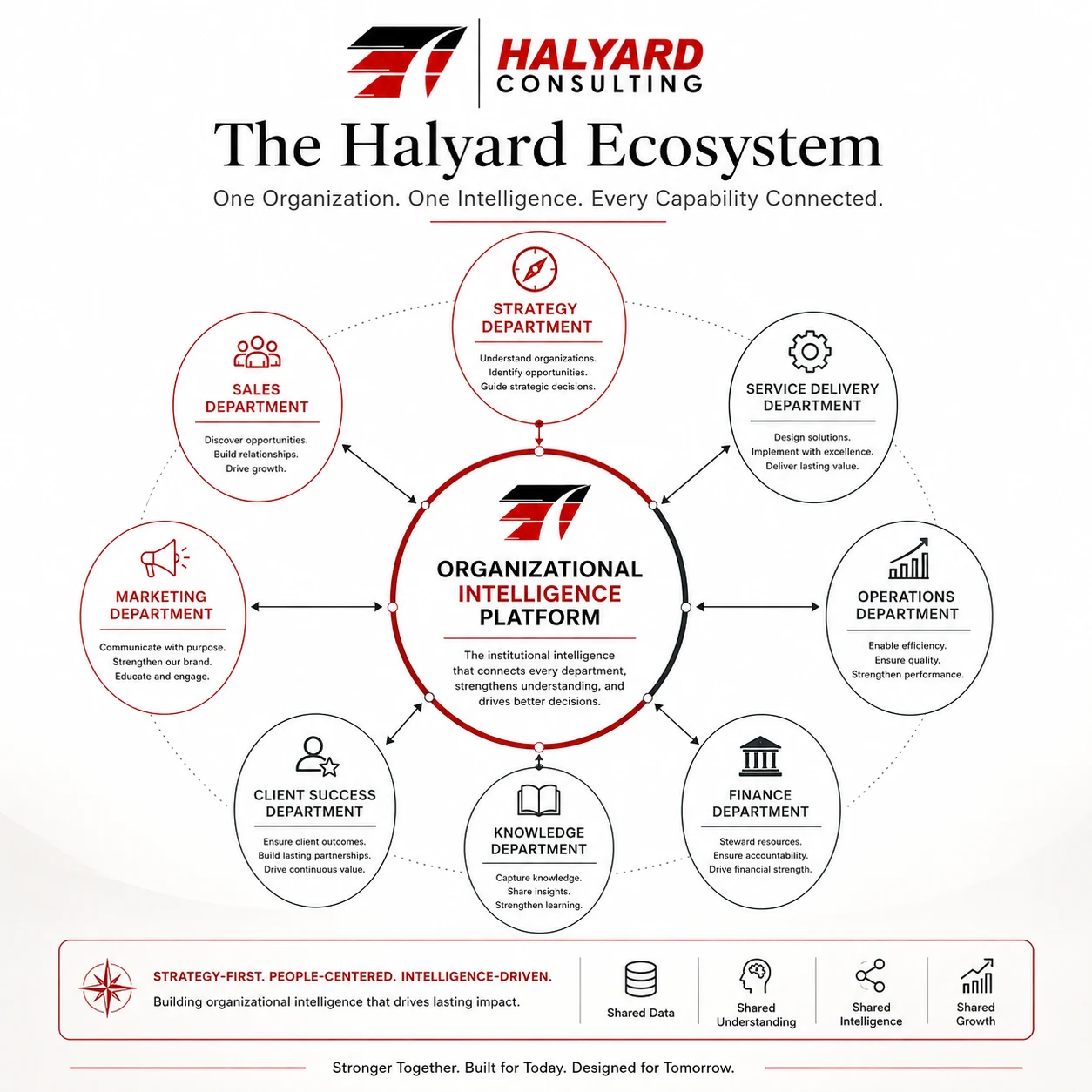
The organizational ecosystem illustrated here is a conceptual model for how connected modernization can work. It is not a prescription for one platform or technology architecture.
In this model, information belongs to the organization—not to an individual application.
Knowledge created in one part of the institution can strengthen another.
A client conversation can inform service planning.
An operational lesson can improve future implementation.
A leadership decision can become institutional knowledge rather than disappear into meeting notes.
A change in strategy can be reflected across departments without requiring every team to reconstruct the meaning independently.
This does not require one enormous system attempting to perform every function.
It requires a connected organizational ecosystem in which specialized capabilities share appropriate context, terminology, governance, and institutional knowledge.
Different departments still perform different work.
The difference is that they no longer operate as isolated islands.
The Role of Governance
Connected technology without governance creates a different form of risk.
The goal is not to make every piece of information available to everyone.
The goal is to ensure that information is structured, protected, accessible, and applied according to clear organizational responsibilities.
Governance establishes:
- who may access information;
- who is responsible for its accuracy;
- which sources are authoritative;
- how decisions are approved;
- where human review remains essential;
- how AI-generated outputs are evaluated;
- how institutional knowledge is preserved; and
- how the organization learns from implementation.
Strong governance does not prevent innovation.
It makes responsible innovation possible.
Organizations can move with greater confidence when leaders understand how new capabilities fit within established authority, risk management, ethical obligations, and long-term strategy.
For a closer examination of these conditions, read why responsible AI begins with organizational understanding.
Modernization as Institutional Strengthening
The purpose of modernization should not be to increase the number of systems an organization owns.
It should be to strengthen the organization’s ability to fulfill its mission.
That may involve technology, but technology is only one part of the work.
Meaningful modernization may also require:
- clarifying how decisions are made;
- redesigning workflows;
- improving documentation;
- defining ownership and accountability;
- strengthening knowledge management;
- aligning departments around common outcomes;
- identifying where automation is appropriate;
- preserving human review where judgment matters; and
- creating mechanisms for continuous organizational learning.
This is why strategy must precede technology.
When leaders understand the institution before choosing the implementation, technology becomes easier to evaluate and more likely to create lasting value.
Instead of asking employees to adapt endlessly to disconnected systems, the organization can design systems around the way value should be created.
How Leaders Should Begin
Leaders do not need to redesign the entire organization at once.
They need to begin with disciplined understanding.
A useful starting point is to examine several fundamental questions:
How does work actually move through the organization?
Formal process diagrams often describe how work is supposed to happen. Modernization requires understanding how it happens in practice.
Where does institutional knowledge live?
If important knowledge exists only in individual inboxes, memories, or informal conversations, the organization remains vulnerable to disruption and repetition.
How are consequential decisions made?
Leaders should understand what evidence is considered, who contributes, who decides, and how the reasoning is preserved.
Where do people compensate for weak systems?
Manual workarounds often reveal deeper gaps in workflow design, governance, data quality, or organizational ownership.
Which technologies strengthen capability—and which merely add complexity?
Every system should have a clear relationship to organizational purpose.
Where could artificial intelligence improve judgment or reduce friction responsibly?
AI opportunities should be evaluated within the context of evidence, governance, risk, accountability, and human oversight.
These questions help leaders move from tool selection to institutional design.
Building Capability Over Time
A connected organization cannot be created through a single implementation project.
It develops through a sequence of deliberate improvements.
Organizations begin by understanding their current condition.
They identify operational friction, knowledge gaps, governance weaknesses, and opportunities for better coordination.
They design a future state grounded in organizational priorities.
They implement improvements in an order that protects continuity and creates measurable value.
They evaluate outcomes and preserve what they learn.
Over time, the organization becomes more capable because each improvement strengthens the foundation for the next one.
This is the difference between installing technology and building institutional capability.
The Future of Work Is Institutional
The future of work will certainly include more artificial intelligence, automation, connected data, and digital services.
But the organizations that benefit most will not necessarily be those that adopt the greatest number of tools.
They will be those that develop the strongest understanding of themselves.
They will know how work creates value.
They will preserve knowledge intentionally.
They will establish governance that enables responsible innovation.
They will use technology to strengthen people rather than displace accountability.
They will connect specialized capabilities without losing institutional coherence.
They will learn from decisions, projects, relationships, and experience.
In other words, they will become smarter organizations.
Halyard Consulting’s Perspective
At Halyard Consulting, we help organizations modernize by first understanding how they operate.
We examine the relationships among leadership, governance, operations, knowledge, people, and technology before recommending change.
Our modernization services are grounded in that institution-first approach.
Because lasting modernization does not come from adding another disconnected application.
It comes from creating an organization in which strategy, governance, institutional knowledge, human judgment, and responsible technology work together as one connected system.
The future of work is not more software.
It is stronger institutions—supported by technology, informed by evidence, and capable of learning continuously.