
Procurement Operations Modernization
Understand qualification workflows, compliance visibility, response coordination, and pursuit governance.
Open Procurement Operations Modernization
Strategy-first institutional modernization
RFP Copilot — Procurement Operations Infrastructure
Procurement teams often need clearer qualification discipline, response ownership, capability alignment, and review visibility before pursuit resources are committed.
RFP Copilot is the public platform name for Halyard's supporting procurement operations infrastructure. It supports procurement modernization and revenue opportunity decision quality after the operating context, governance needs, and service relationship are understood.
Procurement Authority Path
Understand qualification workflows, compliance visibility, response coordination, and pursuit governance.
Open Procurement Operations ModernizationMap response ownership, knowledge readiness, and governance checkpoints before controlled onboarding.
Open Discovery Readiness ArchitectureKeep human review, escalation, auditability, and institutional authority visible.
Open Operational AI Governance FrameworkSee how RFP Copilot relates to Halyard’s supporting platform architecture.
Open Halyard PlatformsClarify how procurement workflows can use AI support while preserving accountable human review.
Open What is human-reviewed AI?Service Context
Halyard first evaluates pursuit workflows, knowledge readiness, governance expectations, decision owners, and response coordination conditions. The platform becomes relevant when that assessment shows that qualification intelligence and governed response coordination would strengthen the operating model.
This keeps RFP Copilot subordinate to Halyard's methodology and service architecture while preserving its public product identity and legacy URL.
Deployed Platform System
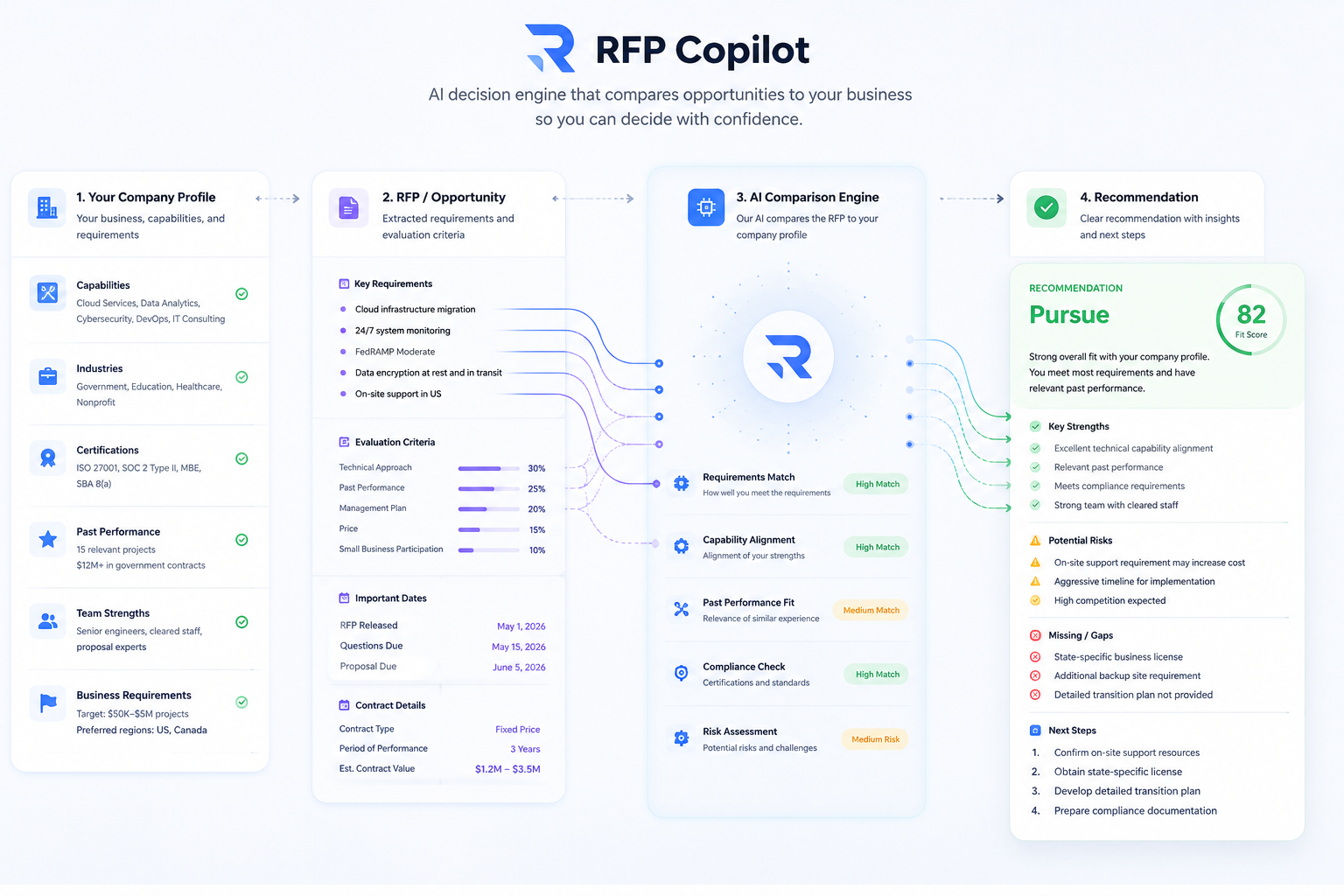
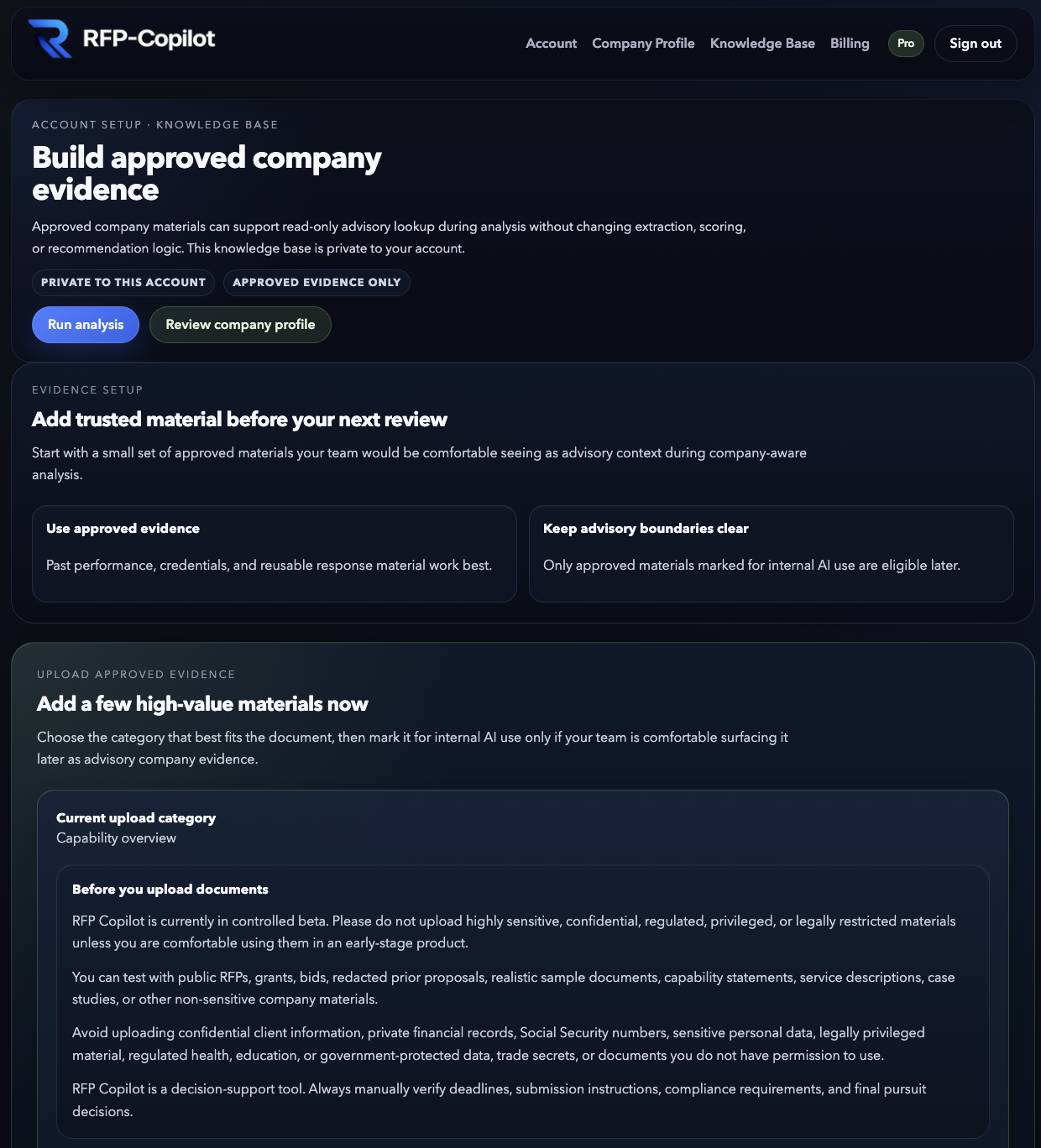
RFP Copilot is presented here as real procurement operations infrastructure: product identity, opportunity review surfaces, company context, knowledge workflows, and governed review paths.
Controlled Beta Access
Access is structured around procurement maturity, response ownership, company context, and human-reviewed workflow discipline. The goal is a useful rollout, not a broad self-serve signup.
Designed Fit
The product is designed for organizations that need better pursuit visibility, clearer qualification decisions, and more consistent response coordination while preserving human review.
Teams that need stronger bid/no-bid discipline, capability alignment, and opportunity triage.
Groups coordinating requirements, evidence, deadlines, reviews, and stakeholder inputs across active opportunities.
Organizations where recurring solicitations require repeatable qualification logic and governed response operations.
RFP Copilot is not positioned for teams expecting software to author and submit responses without accountable review.
Teams without defined reviewers, decision owners, or procurement accountability will need workflow clarity before onboarding.
The system supports qualification discipline; it is not meant to increase low-fit response volume.
Operational Evidence
These screens show how the system presents qualification context, company-aware review, decision outputs, and next-step risk visibility for human review.
Workflow
Opportunity context, requirement signals, and review steps stay visible before response work expands.
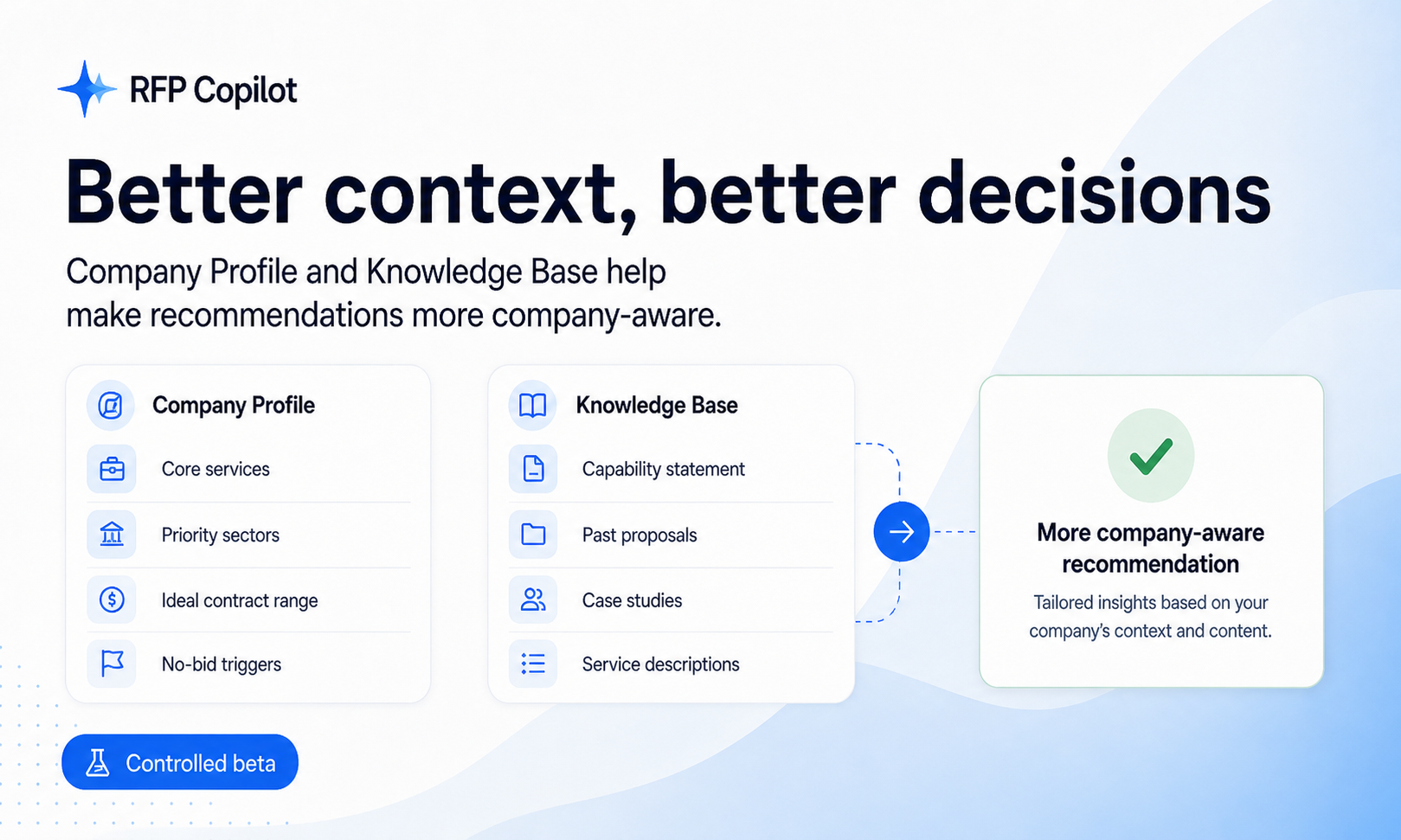 Context
Capability alignment depends on organizational context, relevant evidence, and delivery fit.
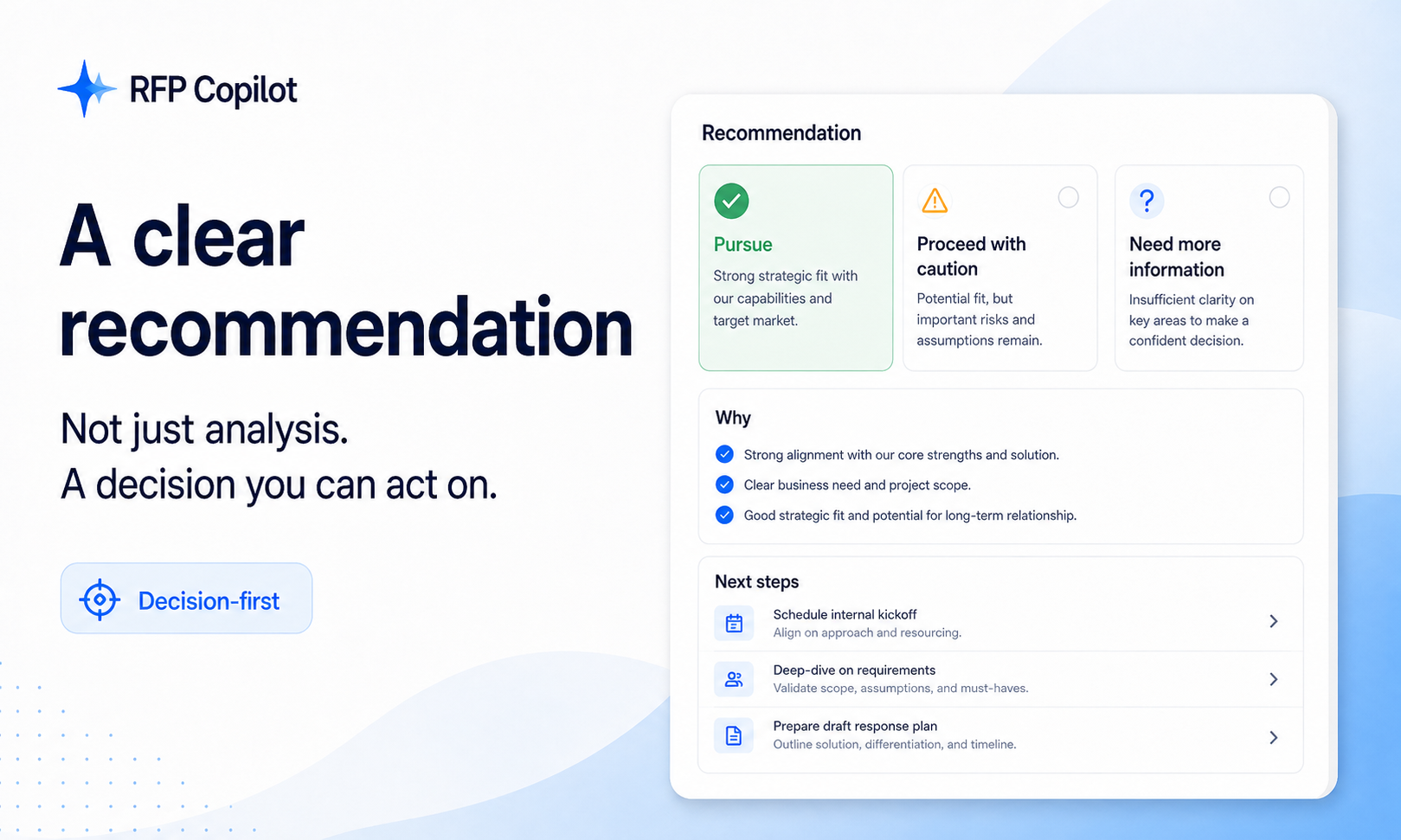 Decision support
Outputs support pursue, clarify, hold, or decline decisions without replacing procurement judgment.
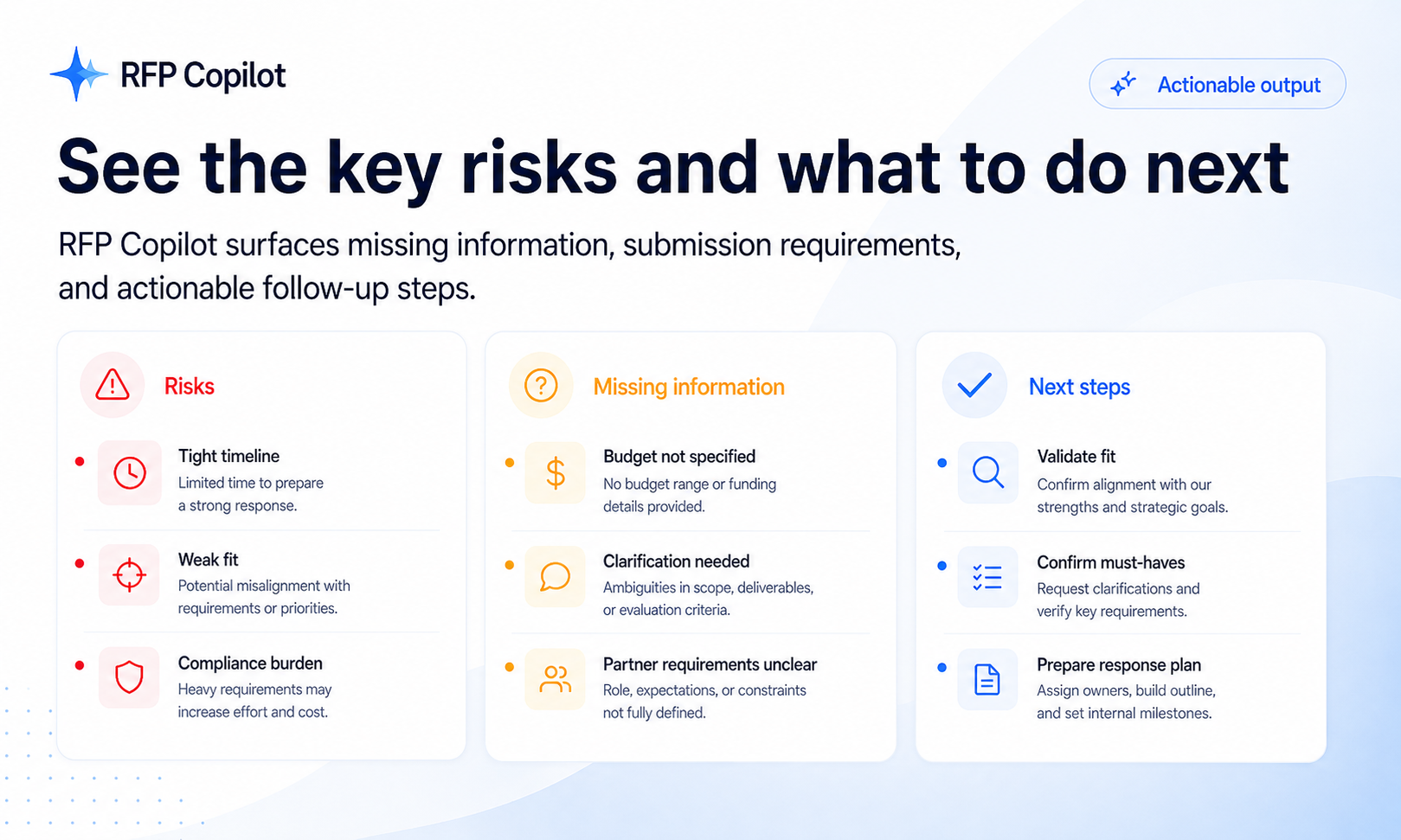 Governance
Risk flags, clarification needs, and owner follow-up help teams govern pursuit work.
Procurement Use Cases
RFP Copilot supports the operating work around pursuit decisions. It does not remove procurement judgment or final submission authority.
Compare opportunity fit, eligibility, effort, deadlines, risks, and expected value before response work expands.
Surface key requirements, missing information, clarification needs, and potential blockers for team review.
Keep legal, technical, operations, executive, and response owners aligned around review needs and milestones.
Track forms, deadlines, eligibility requirements, certifications, attachments, and unresolved compliance questions.
Connect opportunity requirements to organizational strengths, delivery evidence, past performance, and capacity signals.
Preserve human validation, escalation paths, approval logic, and final authority across the pursuit lifecycle.
Qualification Intelligence Infrastructure
RFP Copilot provides a structured qualification layer for opportunity intake, strategic pursuit management, governance-aware evaluation, and institutional readiness visibility.
Capture solicitation context, requirements, deadlines, evaluation criteria, and known constraints.
Assess fit, eligibility, effort level, risk, and response feasibility before work expands.
Compare requirements against organizational strengths, delivery evidence, staffing, and operating model.
Surface compliance obligations, approval needs, escalation paths, and decision ownership.
Support pursue, hold, decline, or clarify decisions with visible rationale and review context.
Sequence stakeholders, documents, milestones, reviews, and submission governance.
Procurement Lifecycle Visibility
Mature pursuit operations depend on milestone tracking, operational sequencing, stakeholder coordination, response management, compliance checkpoints, and institutional orchestration.
Governance-Aware Procurement Workflows
RFP Copilot supports review workflows while preserving human oversight, auditability, escalation pathways, compliance visibility, executive approvals, and institutional accountability.
Provides extraction, risk flags, summaries, coordination signals, and review support.
Procurement, operations, and response teams verify requirements, fit, assumptions, and constraints.
Check deadlines, forms, certifications, terms, submission rules, and required approvals.
Leadership confirms pursuit logic, risk posture, resourcing, and strategic alignment.
Final responsibility, records, unresolved risks, and submission readiness remain visible.
Capability Alignment and Institutional Readiness
RFP Copilot helps teams align opportunities to organizational strengths, evaluate operational capacity, review procurement readiness, plan resources, assess strategic fit, and preserve pursuit discipline.
Map requirements to delivery strengths, experience, qualifications, and proof points.
Assess staffing, response effort, implementation obligations, and delivery readiness.
Identify what must be clarified, assembled, verified, or governed before pursuit.
Evaluate contributors, approvals, timelines, reviews, and executive decision needs.
Compare opportunities against market focus, mission fit, and institutional priorities.
Make pursue, hold, decline, and clarify decisions more consistent and inspectable.
Cross-Functional Response Coordination
RFP Copilot supports the operating model around legal coordination, technical review, executive approval, operations alignment, milestone sequencing, and procurement workflow orchestration.
Terms, certifications, exceptions, risk flags, and approval requirements.
Requirements fit, architecture assumptions, security posture, integrations, and feasibility.
Pursuit logic, resourcing, strategic alignment, risk posture, and final authority.
Delivery model, staffing implications, implementation obligations, and service commitments.
Workback planning, review gates, question deadlines, and unresolved blockers.
Shared visibility across documents, owners, review steps, and submission readiness.
Institutional Knowledge Infrastructure
The system functions as a procurement intelligence layer and operational workflow support system: reusable institutional knowledge, procurement memory, response coordination visibility, and governance-aware knowledge workflows.
Organize capabilities, delivery evidence, operating context, and prior response patterns for review.
Give teams a shared reference point for fit, risks, gaps, and response assumptions.
Preserve opportunity context, decision rationale, review signals, and unresolved questions.
Keep owners, inputs, deadlines, and approval needs visible across the pursuit lifecycle.
Support review boundaries, verification needs, escalation, and accountable decision-making.
Help teams understand what must be true before a pursuit becomes operationally sound.
Human-in-the-Loop Procurement Architecture
RFP Copilot supports operational coordination and review discipline. Governance checkpoints remain visible, escalation pathways exist, and institutional authority stays with the team through final submission.
Institutional context, opportunity signals, requirements, and risk indicators are organized for review.
Teams assess fit, capacity, dependencies, and response implications.
Subject matter owners verify assumptions, evidence, compliance needs, and readiness.
Leadership confirms risk posture, pursuit logic, resources, and accountability.
Submission decisions, responsibility, records, and unresolved issues remain institutionally governed.
Assessment and Institutional Readiness
Halyard's Organizational Intelligence Assessment maps procurement operations readiness, governance-aware modernization planning, workflow alignment, stakeholder responsibilities, institutional knowledge needs, compliance checkpoints, and implementation sequencing.
Discovery activities may support that assessment, but they do not replace it as the canonical service identity. The readiness process clarifies where RFP Copilot should support qualification intelligence, where human review must remain explicit, and how procurement workflows should be staged for responsible adoption.
Onboarding Readiness
Teams do not need a perfect procurement operation before requesting access. They do need enough operating context for the system to support responsible review.
Defined response owner or pursuit decision lead
Company capabilities, service areas, past performance, and differentiators
Human review path for risks, assumptions, evidence, and final decisions
Current intake, qualification, response, and approval steps
Boundaries for sensitive information, compliance checks, and escalation
Procurement or pursuit cadence that makes controlled onboarding useful
Institutional FAQ
These answers clarify how RFP Copilot supports qualification, coordination, and human-reviewed procurement workflows.
RFP Copilot supports opportunity intake, qualification review, capability alignment, response coordination, compliance checkpoint visibility, and pursuit governance for human-reviewed procurement teams.
No. RFP Copilot is designed to support review, routing, risk visibility, and coordination while procurement owners retain final authority over pursuit decisions and submissions.
Discovery is useful when procurement workflows, knowledge sources, review ownership, compliance checkpoints, or response governance need to be mapped before controlled onboarding.
Procurement Operations Infrastructure
Align opportunity intake, capability review, governance checkpoints, stakeholder coordination, institutional knowledge, and human-led pursuit decisions before response resources are committed.